Start with your stage
Pick the size closest to your business. The five things to focus on first change as you grow.
RuleA law or official requirementFactA published figureTipAdvice from the industry
Grow sales from the stores you already serve
The cheapest growth is more sales on stops the truck already makes. The store, the drive and the relationship are already paid for.
- FactMost convenience stores are owner-run.
NACS counts 151,975 convenience stores in the U.S. as of December 31, 2025, and 63% of them belong to single-store operators.1 At most of those stores, one person decides what goes on the shelf, so a steady relationship with the owner matters.
- TipAdd small stops along the route you already run.
Route Consultant points out that small convenience stores added along an existing route bring in revenue for little extra driving, and the gains build over time.2
- TipAsk for better shelf space before looking for new stores.
Endcaps, the checkout area and eye-level shelves can lift sales without a new account. Store managers control that space, which is why regular, reliable visits matter.2
- TipStock each store for what it actually sells.
Track the fastest-moving products at each location, keep those shelves full, and stock up before seasonal peaks such as holidays, big sporting events and summer.2
Protect your margin as costs change
Volume doesn’t help if each case earns less than it used to. Pricing habits that work with one truck have to be written down once several drivers quote prices.
- TipKnow the margin on every product.
Work out the cost per unit, your price to the store and your margin for each item, so you know which products carry the route.
Snack markup and margin calculator → - TipPass supplier increases on early.
ProfitOptics, a pricing firm for distributors, advises telling customers about an increase before the higher-cost stock arrives, and acting first on accounts with low or negative margins.3
- FactPrice increases get missed.
ProfitOptics reports that across its distributor clients, 20 to 30% of price increases were delayed or missed. It recommends checking regularly for items whose cost went up while the selling price stayed the same.3
- TipDon’t let discounts undo the increase.
The same source warns that falling back to the last price a customer paid, or discounting without seeing the margin, can erase an increase.3 One written price list per store, the same for every driver, prevents it.
- TipKnow what each stop earns.
A store that buys less than the stop costs gets more expensive with every truck you add. Compare each store’s sales with the cost of the visit.
Route profit per stop →
Keep credits from growing with volume
- TipRotate at every visit and pull expired product.
Move older stock to the front, put fresh product behind it, and remove expired items promptly. Route Consultant notes that stale product on the shelf cuts profit and hurts your standing with store managers.2
- TipWrite down every credit with its reason.
Record the store, product, date code, quantity and reason each time product comes back. With more drivers, it is the only way to see which stores and products send the most back.
Credit memo and stale return log →
Put cash controls in place before you add drivers
When the owner drives the only truck, the owner’s memory fills the gaps. Once someone else collects the money, the records have to do that job.
- TipSettle every truck the same day.
Match each truck’s cash and checks to its invoices before the driver goes home, and have someone other than the driver count or check the count.
Route settlement sheet → - RuleShortages and paychecks.
The U.S. Department of Labor says an employer can’t take a cash shortage from an employee’s pay when it would bring pay below the federal minimum wage or cut into overtime owed. Some states set stricter limits.4
- RuleLarge cash payments.
A business that receives more than $10,000 in cash in one transaction, or in related transactions, must file IRS Form 8300 within 15 days.5
Hiring drivers
Route Consultant’s advice is to bring on a driver or helper as sales grow, so the owner can spend more time managing accounts and finding growth.2 These are the federal rules that come with the first hire. State rules can add to them.
- RuleOvertime applies to commission pay too.
Employees covered by the Fair Labor Standards Act get at least one and a half times their regular rate for hours over 40 in a workweek. Weeks can’t be averaged, and for workers paid by commission the regular rate comes from that week’s total pay divided by hours worked.6
- RuleMost route drivers aren’t “outside sales.”
Federal rules treat a driver who sells as exempt from overtime only if selling is the main part of the job. Drivers who mainly deliver set amounts to regular customers, or mostly rotate and arrange stock, generally don’t qualify.7
- RuleThe motor carrier exemption and small trucks.
A separate overtime exemption can cover drivers of trucks in interstate commerce, but it doesn’t apply in any week the driver works on vehicles of 10,000 pounds or less.8 Many snack routes run vans and box trucks near that line, so check each vehicle’s rating.
- RuleEmployee or contractor.
The IRS looks at three kinds of evidence: behavioral control, financial control and the type of relationship. When it’s unclear, either side can file Form SS-8 for an official determination.9
- RuleWorkers’ compensation.
The SBA says businesses with employees must carry workers’ compensation, unemployment and disability insurance, with state rules on top.10 In Florida, for example, non-construction employers need workers’ compensation at four or more employees, and corporate officers count.11
Adding a truck
The truck you add decides which federal rules apply. These thresholds are for interstate commerce; your state may apply its own rules to trucks that never leave the state.
- RuleUSDOT number at 10,001 pounds.
A vehicle rated or weighing 10,001 pounds or more used in interstate commerce needs a USDOT number. FMCSA lists 38 states plus Puerto Rico that also require one for some trucks that stay in the state.12
- RuleCDL at 26,001 pounds.
A Class B commercial driver’s license covers a single vehicle rated at 26,001 pounds or more. Class A covers combinations of 26,001 pounds or more where the towed unit is over 10,000 pounds.13
- RuleDriver logs on local routes.
Under FMCSA’s short-haul exception, property-carrying drivers who stay within 150 air miles of their usual work location and return within 14 hours are exempt from logbook requirements.14
- RuleVehicle inspection reports.
FMCSA no longer requires interstate property-carrying drivers to submit a vehicle inspection report when no defect was found or reported.15 Defects still have to be reported and fixed.
Paying for growth
A second truck, a bigger warehouse or a route purchase usually needs financing. These SBA-backed programs are made through lenders, who decide on each loan.
- RuleSBA microloans, up to $50,000.
Microloans go up to $50,000, average about $13,000, and can run up to seven years. They can pay for working capital, inventory, equipment and similar costs, but not existing debts or real estate.16
- RuleSBA 7(a) loans for larger amounts.
The standard 7(a) loan goes up to $5 million. 7(a) Small goes up to $350,000, and SBA Express up to $500,000 with a 50% SBA guarantee.17
- TipBuying routes.
Route Consultant notes that buying more routes can add income and spread fixed costs, and works best once systems are in place to handle the extra volume.2
Snack route value calculator →
Insurance as the fleet grows
- FactProduct liability for distributors.
The SBA describes product liability insurance as coverage for businesses that make, wholesale, distribute or sell products, protecting against losses when a product causes injury.10
- TipA business owner’s policy doesn’t cover trucks.
The Insurance Information Institute says a business owner’s policy has no vehicle coverage, so trucks need a separate commercial auto policy. If employees drive their own cars for work, non-owned auto coverage can be added. It notes many insurers recommend $1 million in business auto liability, with $500,000 as a minimum.18
Warehouse and suppliers
- RuleFDA food facility registration.
Facilities that hold food for consumption in the U.S. must register with the FDA unless an exemption applies. Retail food establishments are exempt. Registration is renewed from October 1 to December 31 of each even-numbered year, and there is no fee.19 State and local permits for food warehouses are separate.
State and federal steps for a snack route → - TipCheck sales tax in every state you deliver to.
Candy, soft drinks, chips and grocery food are taxed differently from state to state. A new territory across a state line can change what goes on the invoice.
Snack sales tax by state →
Move off paper before the next truck
The office work on a paper route grows with every truck: copying invoices, adding up payments, chasing balances and matching credits. Route Consultant’s point that buying routes works best once systems are in place applies to adding trucks too.2
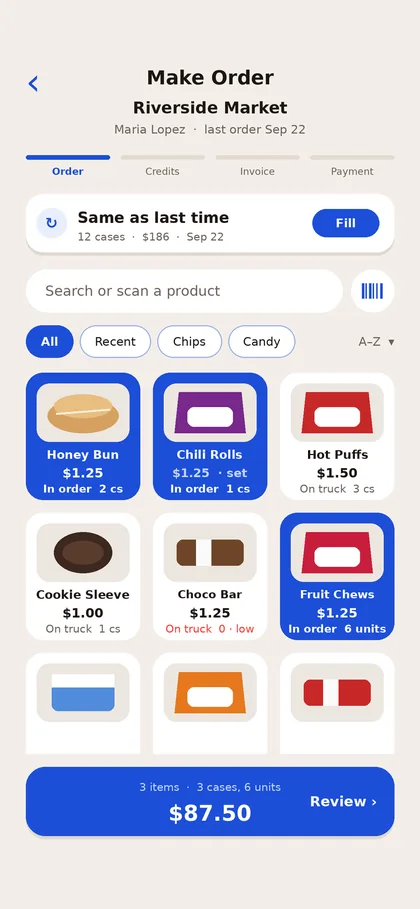
In Tallysnack, the driver builds each order on the phone, with the store’s last order one tap away and what’s on the truck shown next to each product.
Invoices, credits and payments are recorded at the store, so the office doesn’t type them again at night.
For a side-by-side look at the options, see paper invoice books vs route software and route software vs Excel.
Growth checklist
Tick off what is already in place. Your ticks are saved in this browser.
For a scored version, take the route business checkup: 20 questions with a list of what to fix first.
Questions
When should I hire my first driver?
Route Consultant suggests bringing on help as sales grow, so the owner can manage accounts and look for growth.2 Before the first hire, put the price list, the end-of-day settlement and the credit records in writing, since the new driver won’t have the owner’s memory to fall back on.
Do route drivers get overtime?
Usually, if they are employees covered by the Fair Labor Standards Act. The outside sales exemption generally doesn’t fit drivers who mainly deliver set amounts to regular customers, and the motor carrier exemption doesn’t apply in weeks spent on vehicles of 10,000 pounds or less.7,8 State law can add requirements. Ask an employment lawyer about your setup.
Do I need a CDL to run a snack route?
Not for most vans and smaller box trucks. A Class B CDL is needed for a single vehicle rated at 26,001 pounds or more.13 A USDOT number starts at 10,001 pounds for interstate commerce, and many states have their own rules.12
Is it better to add stores or add trucks?
Most of the advice gathered here points to filling the existing route first: more stops along the way, better shelf space and stock matched to each store. A new truck makes sense once the current routes are full and the cash, credit and price records work without the owner checking every invoice.
Is this legal or financial advice?
No. It is general information gathered from the sources listed below. Rules change and vary by state, so confirm with the agency, your accountant, your insurance agent or a lawyer before you act.
Related for DSD teams
Add trucks without adding paperwork.
Tallysnack puts invoices, credits, payments and the end-of-day close on the driver’s phone and the office screen, for one truck or twenty. We are building it now. Join the list for monthly updates on the build.
Who we are. Tallysnack makes route software for direct store delivery (DSD) snack, candy and beverage distributors. It’s built by a family that has run snack routes for more than 30 years, and it is in development. See how it works
Sources
Reviewed October 21, 2026. The advice from each source is summarized in our own words; read the source for the full text.
- NACS, U.S. convenience store count (NACS/NIQ TDLinx, as of December 31, 2025)
- Route Consultant, How to succeed as a snack route owner
- ProfitOptics, Turning cost increases into margin protection: a practical guide for distributors
- U.S. Department of Labor, Wage and Hour Division: Fact Sheet #16, deductions from wages under the FLSA
- IRS, Form 8300 and reporting cash payments of over $10,000
- U.S. Department of Labor, Wage and Hour Division: Fact Sheet #23, overtime pay under the FLSA
- 29 CFR 541.504, Drivers who sell (Cornell Legal Information Institute)
- U.S. Department of Labor, Wage and Hour Division: Fact Sheet #19, the motor carrier exemption under the FLSA
- IRS, Independent contractor (self-employed) or employee?
- U.S. Small Business Administration, Get business insurance
- Florida Division of Workers’ Compensation, Coverage requirements
- FMCSA, Do I need a USDOT number?
- FMCSA, Commercial driver’s license: drivers
- FMCSA, Summary of hours of service regulations
- FMCSA, Inspection, repair and maintenance: driver vehicle inspection report (DVIR)
- U.S. Small Business Administration, Microloans
- U.S. Small Business Administration, Types of 7(a) loans
- Insurance Information Institute, Business vehicle insurance
- U.S. Food and Drug Administration, Food facility biennial registration fact sheet