Credit memo or a credit line on the invoice?
A credit memo is a separate document that lowers what a store owes you. A credit line on the invoice does the same job inside the delivery invoice. Both are fine. What matters is that every credit is written down with the product, the count, the price and the reason.
- Use a credit line when the credit is settled on the spot, at the same visit as a delivery. One piece of paper covers both.
- Use a credit memo when product is picked up without a delivery, when a credit is found after the invoice was written, when a price was charged wrong, or when the credit will be applied to a later invoice or an open balance.
What every credit memo should show
- Its own memo number, separate from your invoice numbers, so a credit can never be mistaken for a sale.
- The store, the date and the driver, so anyone can tell where and when the product came back.
- Each product with its date code, so you can check the item really was out of date and that it is one you sell.
- Quantity and the price the store paid, since the credit is worth what the store was charged, not what the product cost you.
- A reason for every line: expired, damaged, wrong item or pricing correction.
- Where the credit goes: taken off a named invoice, applied to the store’s open balance, or paid back.
- The printed name of the store person who agreed to the count, if your company uses signatures.
The templates
Fill in the memo for a single credit, or switch to the log to record every credit over a week or a month. Totals add up as you type. Press “Load example” to see one filled in.
CREDIT MEMOThis credit lowers the amount the store owes.
Stale return log
Credits 0Units 0Total $0.00
By store
By product
By reason
A general business template, not accounting, tax or legal advice. Example data is made up.
Reading the log: where the stale comes from
One credit tells you about one bag. A month of credits tells you about the route. Sort the log three ways and each view points at a different fix.
- By store. A store with far more credits than its neighbors is usually getting more than it sells. Cut the order there before cutting the product everywhere.
- By product. A product that comes back from many stores is a product problem: wrong flavor for the area, too short a shelf life, or a case size that is too big for small stores.
- By reason. Damaged product points to handling on the truck or in the back room. Wrong items point to the order or the picking, not the store.
The share of sales lets you compare months of different sizes. Track it for your own route over time rather than against an outside number, because it varies with what you sell and how often you visit. Our expired product credits guide covers how credits get lost between the shelf and the invoice and has a calculator for their cost.
Using the Excel version
The workbook has three sheets. Credit memo is the form above, with totals that fill in. Stale log takes one row per credit. Summary totals the log by store, by product and by reason: type your store and product names in its first column once and the totals fill in, with a cell for sales to show credits as a share of sales.
Questions
Is a credit memo the same as a refund?
Not usually. A credit memo lowers what the store owes, either on an invoice or on its open balance. A refund pays money back. On a route, most credits are taken off the next invoice rather than paid out in cash.
Should a credit be at the store’s price or my cost?
At the price the store paid. That is the amount the store was charged for the product, so it is the amount that comes off. What it cost you matters for your own profit numbers, not for the memo.
Do credit memos need their own numbers?
It helps. A separate series, such as CM-0001, keeps credits apart from sales and makes a missing memo easy to notice. Ask your accountant whether your state or your bookkeeping system has a rule about numbering.
Does a credit memo change sales tax?
It can, if the original sale was taxed. How a credit is treated depends on your state and the product. Ask your accountant, or see our snack sales tax by state table as a starting point.
What if the store won’t agree to the count?
Count together, line by line, and write down the number you both agree on. If the store keeps product it says is expired, note that on the memo too, so the record shows what happened.
Is what I type sent anywhere?
No. Both templates run in your browser and save only in this browser. The CSV file is made on your device. See the privacy notice at the bottom of the page.
Related for DSD teams
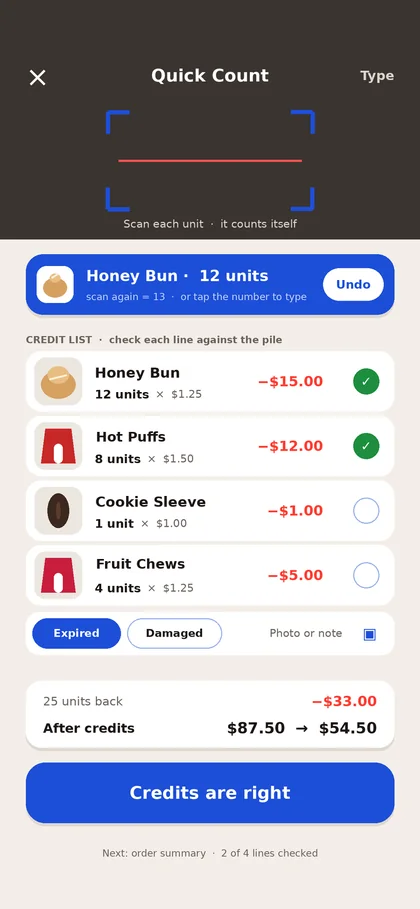
Every credit on the invoice, with its reason.
Tallysnack lets the driver count expired product on the phone, takes the credit off the invoice and shows the office which stores and products send the most back. We are building it now. Join the list for monthly updates on the build.
Who we are. Tallysnack makes route software for direct store delivery (DSD) snack, candy and beverage distributors. It’s built by a family that has run snack routes for more than 30 years, and it is in development. See how it works